Race Condition in Organization Membership — Legacy API Abuse and Sensitive Data Exposure

1. Introduction
While testing the organization’s user-management functionality, I identified a business-logic restriction limiting organizations to five members. Each additional member required an additional payment of $50.
This made the membership functionality an interesting target for testing, particularly for race conditions and business-logic bypasses.
The initial objective was to understand how the application enforced the membership limit and whether the same controls were consistently applied across different API versions.
The investigation eventually revealed a chain involving:
- Legacy API functionality
- Inconsistent authorization controls
- Race-condition-based membership-limit bypass
- Mass account addition
- Sensitive user information disclosure
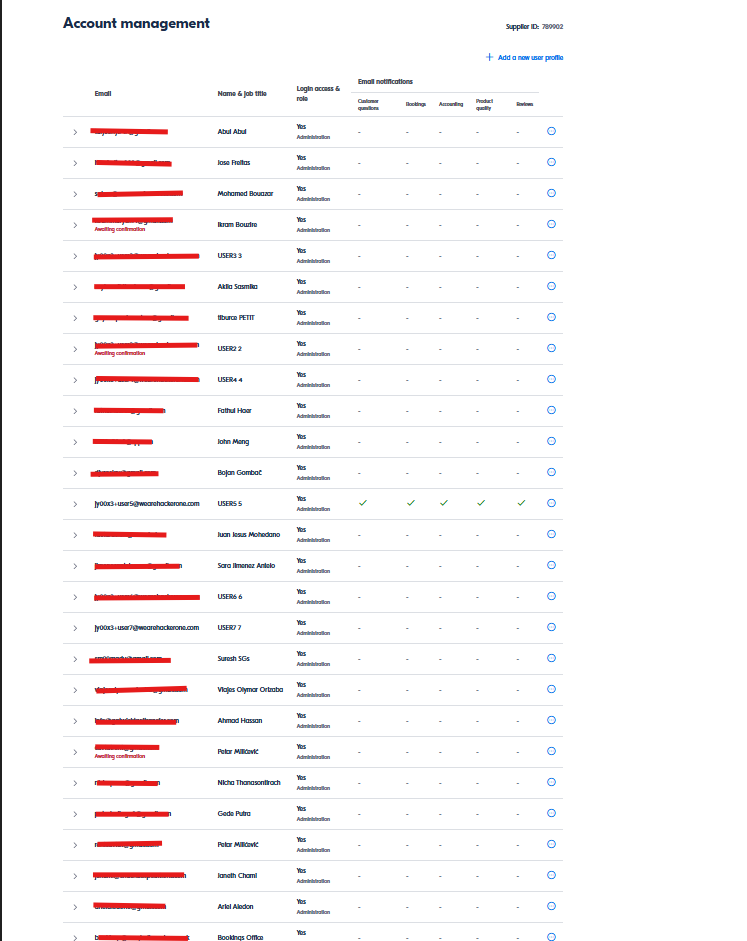
The complete attack chain ultimately allowed more than 200 users to be added to an organization that was intended to be limited to five members.
2. Mapping the Modern API Workflow
I began by observing the normal process used by the application when connecting a user to an organization.
The workflow involved several API requests under /api/v2.
At a high level, the process was:
1
2
3
4
5
6
7
8
9
10
Save User Data
      |
      v
Assign UUID
      |
      v
Authorization Check
      |
      v
Connect User to Organization
2.1 Saving User Data and Assigning a UUID
The first stage saved the user’s information and generated an identifier that was subsequently used by the membership workflow.
1
POST /api/v2/...
The assigned UUID became an important object identifier for subsequent authorization testing.
2.2 Authorization Check
The application then performed an authorization check to determine whether the user could be added to the organization.
1
POST /api/v2/...
This indicated that the modern implementation was explicitly checking whether the requested membership operation was permitted.
2.3 Connecting the User
The final stage connected the user to the organization:
1
POST /api/v2/connect
At this point, the application appeared to enforce the organization’s membership restriction.
Rather than immediately attempting to bypass the restriction, I continued investigating how the functionality was implemented and whether older versions of the API exposed alternative functionality.
3. Historical API Documentation
Because the application was using versioned APIs, I searched historical documentation using the Wayback Machine.
This revealed an older API implementation containing:
1
POST /api/v1/add-user
Unlike the newer workflow, the legacy endpoint accepted a user UUID directly.
This was significant because it provided an alternative path for performing the same general membership operation without necessarily going through the complete /api/v2 workflow.
The next step was therefore to understand how the UUID was generated and whether arbitrary user accounts could be targeted.
4. UUID Analysis
During testing, I observed that the UUID generation process appeared to incorporate information related to the user’s registration, including:
1
2
3
4
5
Signup Time
+
First Name
+
6 Random Characters
I attempted to construct the UUID of a specific target user using the observed pattern.
The attempt was unsuccessful.
This indicated that simply understanding the apparent UUID structure was insufficient to reliably identify a specific account.
I therefore moved away from targeted UUID prediction and focused on the behavior of the legacy endpoint itself.
5. Testing the Legacy Add-User Endpoint
I tested randomly generated UUID values against:
1
POST /api/v1/add-user
The legacy functionality allowed valid account identifiers to be processed, but the organization’s five-member restriction was still enforced.
At this stage, the situation was:
1
2
3
4
5
Maximum Members: 5

Sequential Requests:

5 Members → Additional Requests Rejected
The endpoint itself was therefore not sufficient to bypass the membership restriction through sequential requests.
This led to the next question:
Is the five-member limit enforced atomically, or is it implemented as a check followed by a separate database operation?
6. Identifying the Race Condition
The membership operation appeared to follow a logical sequence similar to:
1
2
3
4
1. Check current member count
2. Verify that the limit has not been reached
3. Add the new member
4. Update the organization membership state
This type of implementation can become vulnerable if multiple requests perform the validation step before any of them commits the resulting state change.
Conceptually:
1
2
3
4
5
6
7
8
9
10
11
12
Request A ─┐
Request B ─┤
Request C ─┤
Request D ─┤──> Check member count
Request E ─┘
                |
                v
          Multiple requests
          observe valid state
                |
                v
          Multiple additions
The security property that needed to be tested was therefore the atomicity of the membership limit.
7. Exploiting the Race Condition
I used Burp Suite Turbo Intruder to send concurrent requests against the legacy membership endpoint.
The purpose was to determine whether simultaneous requests could bypass the membership invariant.
The organization was initially restricted to:
1
5 members
Under concurrent execution, however, the application processed a large number of membership operations before the membership state could be consistently enforced.
The resulting state exceeded:
1
200 members
despite the intended five-member limit.
The important observation was that the issue was not caused by modifying the membership-limit parameter.
Instead, the vulnerability resulted from concurrent execution of otherwise valid requests.
This is characteristic of a race condition / time-of-check-to-time-of-use (TOCTOU) vulnerability.
8. Business Logic Impact
The race condition had a direct business impact because the organization’s membership model required payment for additional members.
The intended model was:
1
2
3
4
5
6
7
5 Members
    |
    v
Additional Member
    |
    v
$50 Additional Cost
The race condition allowed the membership constraint to be bypassed and more than 200 accounts to be added.
Therefore, the vulnerability affected both:
- The application’s technical access-control model
- The organization’s subscription and billing logic
The issue demonstrated that the membership quota was enforced at the application level but was not sufficiently protected against concurrent requests.
9. Legacy Endpoint Discovery After Membership Bypass
After establishing the membership-limit bypass, I continued reviewing the legacy API functionality.
I identified three additional endpoints associated with organization members.
These endpoints exposed different categories of user information:
1
2
3
4
5
1. First Name / Last Name / Contact Information

2. 2FA Status / 2FA Method

3. Connected Organizations
This significantly expanded the impact of the initial race condition.
10. User Profile and Contact Information
The first legacy endpoint exposed basic identity information associated with a member.
The returned data included:
1
2
3
First Name
Last Name
Contact Information
The concern was that the endpoint could be queried for accounts made accessible through the vulnerable membership workflow.
This transformed the issue from a simple quota bypass into a potential unauthorized information-disclosure vulnerability.
11. Two-Factor Authentication Information
The second endpoint exposed security-related account metadata.
The response included:
1
2
2FA Status
2FA Method
For example:
1
2
2FA Status: Enabled
2FA Method: Authenticator App
Although this information did not expose the authentication secret itself, it disclosed the security configuration of the account.
This represents sensitive security metadata that should only be accessible to appropriately authorized users.
12. Organization Membership Information
The third endpoint exposed information about organizations associated with the account.
Conceptually, the response could identify relationships such as:
1
2
3
4
5
6
7
User
 |
 +-- Organization A
 |
 +-- Organization B
 |
 +-- Organization C
This disclosed additional information about the user’s organizational relationships.
Combined with the profile and security endpoints, this created a broader user-information disclosure issue.
13. Complete Attack Chain
The complete attack chain can be summarized as follows:
1
2
3
4
5
6
7
8
9
10
11
12
13
14
15
16
17
18
19
20
21
22
23
24
25
26
27
28
29
30
31
32
33
34
35
36
37
38
39
40
41
42
43
44
45
46
47
48
49
50
51
52
53
54
55
56
57
58
Organization limited to 5 members
                |
                v
Additional members require $50
                |
                v
Map /api/v2 membership workflow
                |
                +--> Save user data
                |
                +--> Assign UUID
                |
                +--> Authorization check
                |
                +--> /api/v2/connect
                |
                v
Review historical API documentation
using the Wayback Machine
                |
                v
Discover /api/v1/add-user
                |
                v
Analyze UUID generation
                |
                v
Attempt targeted UUID generation
                |
                v
Targeted UUID attempt fails
                |
                v
Test random UUIDs
                |
                v
Five-member limit remains enforced
                |
                v
Race-condition testing
                |
                v
Turbo Intruder
                |
                v
Concurrent requests
                |
                v
More than 200 users added
                |
                v
Discover legacy member endpoints
                |
                +--> Name / Contact Information
                |
                +--> 2FA Status / 2FA Method
                |
                +--> Connected Organizations
14. Impact
The complete chain demonstrated the ability to:
- Bypass the intended five-member organization limit.
- Add more than 200 users through concurrent requests.
- Circumvent the business logic requiring payment for additional members.
- Abuse legacy API functionality.
- Access member profile and contact information.
- Retrieve 2FA status and authentication method.
- Identify organizations associated with users.
The finding therefore combined a race condition, business-logic bypass, and unauthorized information disclosure.
The most significant impact was the ability to violate an organization-level security and billing invariant at scale.
18. Conclusion
The assessment began with a straightforward business rule: organizations were limited to five members, with additional members requiring an additional $50 payment.
By mapping the modern /api/v2 workflow, reviewing historical documentation, identifying the legacy /api/v1/add-user endpoint, analyzing UUID behavior, and testing the membership operation under concurrent execution, I identified a race condition that allowed more than 200 users to be added despite the intended membership restriction.
Further analysis of the legacy API revealed additional endpoints exposing:
1
2
3
4
5
6
7
8
9
10
11
12
13
First Name / Last Name / Contact Information

            |

            v

2FA Status / 2FA Method

            |

            v

Connected Organizations
The final attack chain was:
1
2
3
4
5
6
7
8
9
10
11
12
13
14
15
16
17
18
19
Business Logic Restriction
          |
          v
Legacy API Discovery
          |
          v
Race Condition
          |
          v
Membership Limit Bypass
          |
          v
200+ Unauthorized Additions
          |
          v
Legacy Member Endpoints
          |
          v
Sensitive Information Disclosure
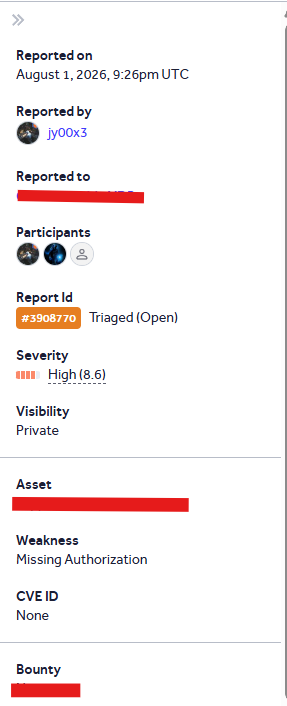
The overall impact warrants High severity consideration because the vulnerability combined a scalable race-condition-based business-logic bypass with unauthorized access to sensitive member information.
The primary technical lesson is that business-logic controls must be enforced atomically and consistently across every API version.
A membership limit that works correctly for sequential requests is not sufficient if concurrent requests can violate the underlying invariant.